
Free Shipping on orders over $50.00 USD
Can Dogs See Color?

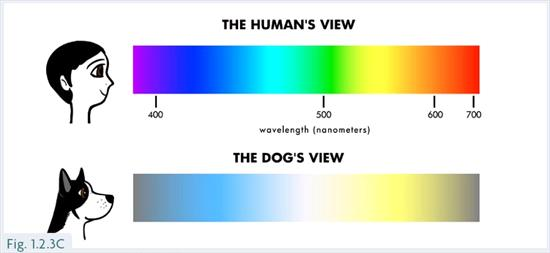
For years, many people assumed dogs could only see in black and white. Modern research, however, paints a different picture. Studies of their eyes and behavior show that while dogs don’t perceive the full spectrum of colors like humans do, they are far from color-blind.
Instead of a dull grayscale world, dogs actually see a limited but real range of colors.
Are Dogs Really Color Blind?
For many years, people assumed dogs could only see the world in black and white. Modern research, however, shows that this isn’t the case. While their vision is limited compared to ours, dogs are not completely color blind—they simply see a narrower range of colors.
Dogs evolved as hunters, relying more on movement and night vision than on vibrant color detail. Their eyes reflect this adaptation: they have larger lenses to pull in more light, a special reflective layer that sharpens vision in the dark, and far more rod cells than cones. Rods are excellent for detecting motion and seeing in dim light, while cones are responsible for color. Because dogs have fewer cones than humans, they don’t process the full spectrum of color that we do.
Why Human and Dog Vision Differ
Humans and some primates are what’s called trichromatic—we have three types of cone cells that detect different wavelengths of light, including those for red, green, and blue. Dogs, however, are dichromatic, meaning they have only two types of cones. Without the red-green cones, their vision resembles that of a person with red-green color blindness.
Instead of seeing bright reds and vibrant greens, dogs interpret those shades as dull brown or gray. But they aren’t stuck in a world of black and white—yellows and blues stand out clearly to them, and combinations of those colors shape much of how they view their surroundings.
Interestingly, some animals see even more colors than humans. Certain birds and fish are tetrachromatic, with a fourth cone type that allows them to detect ultraviolet light, giving them a richer spectrum than either people or dogs.
How the World Looks to a Dog
To a human eye, a red ball tossed onto green grass is easy to spot. To a dog, that same ball may blend into the background, appearing like a dark, muddy blob. A bright yellow tennis ball or a blue toy, on the other hand, stands out sharply, which explains why dogs often show a clear preference for those colors.
In short, dogs can see yellows, blues, and combinations of the two, but much of the rest of their world appears muted or washed out compared to what we see. That vibrant green lawn may look faded and dull to your pup, and that vivid red cushion might appear brown.
What This Means for Pet Owners
Knowing how dogs see can make a big difference when choosing toys, training tools, or even playtime equipment. Opting for yellow or blue toys makes it easier for your dog to track them across grass, water, or indoors. By contrast, red, pink, or orange toys can be tough for dogs to distinguish and might get overlooked.
If you’re teaching your dog to retrieve, play fetch, or differentiate between objects, selecting colors they can actually see gives them a better chance at success. In the end, it’s not that your dog isn’t interested—it may just be that the toy is invisible to them against the background.

Engaging Automatic Fetch Ball
$24.99
✅ Intelligent motion sensor for auto bouncing & rolling
✅ Colorful RGB LED lights for visual stimulation
✅ USB rechargeable – no batteries needed
✅ Durable, pet-safe materials
✅ Great for dogs and cats of all sizes
✅ Helps reduce boredom, stress, and separation anxiety
Final Thoughts
Dogs may not see the world in the same vibrant colors that we do, but that doesn’t mean their vision is limited or dull. Their eyes are perfectly adapted for detecting movement, seeing in low light, and picking out the colors that matter most to them—like blue and yellow.
Understanding how dogs perceive color can help you make smarter choices for toys, training tools, and everyday items, ensuring your pup can see and enjoy them fully. So next time you toss a ball or pick out a toy, remember: what looks bright and exciting to you might not stand out to your dog at all. Choosing the right colors can make playtime more fun and successful for both of you.